Almost everyone has lived the small daily frustration. You walk from the street into your own home or office, the call is fine one moment, and then the voice breaks up, the bars vanish, and you find yourself drifting toward a window or standing awkwardly in a doorway just to keep a conversation alive. It is a strange irony of modern life that the place where we spend most of our time is often the place where our phones work worst. The femtocell was invented to solve exactly this problem, and understanding how it works reveals a great deal about the hidden architecture of mobile networks.
The core difficulty is physical. Mobile signals travel from large towers, known as macrocells, that are designed to blanket wide outdoor areas. Those signals are strong in the open, but walls, especially thick ones made of concrete, brick, or coated glass, absorb and scatter radio waves. By the time the signal has fought its way through the outer shell of a building and into an interior room, much of its strength is gone. This matters more than it might seem, because a large share of all mobile traffic, roughly a third by common estimates, actually happens indoors. In other words, the network struggles most precisely where we use it most.
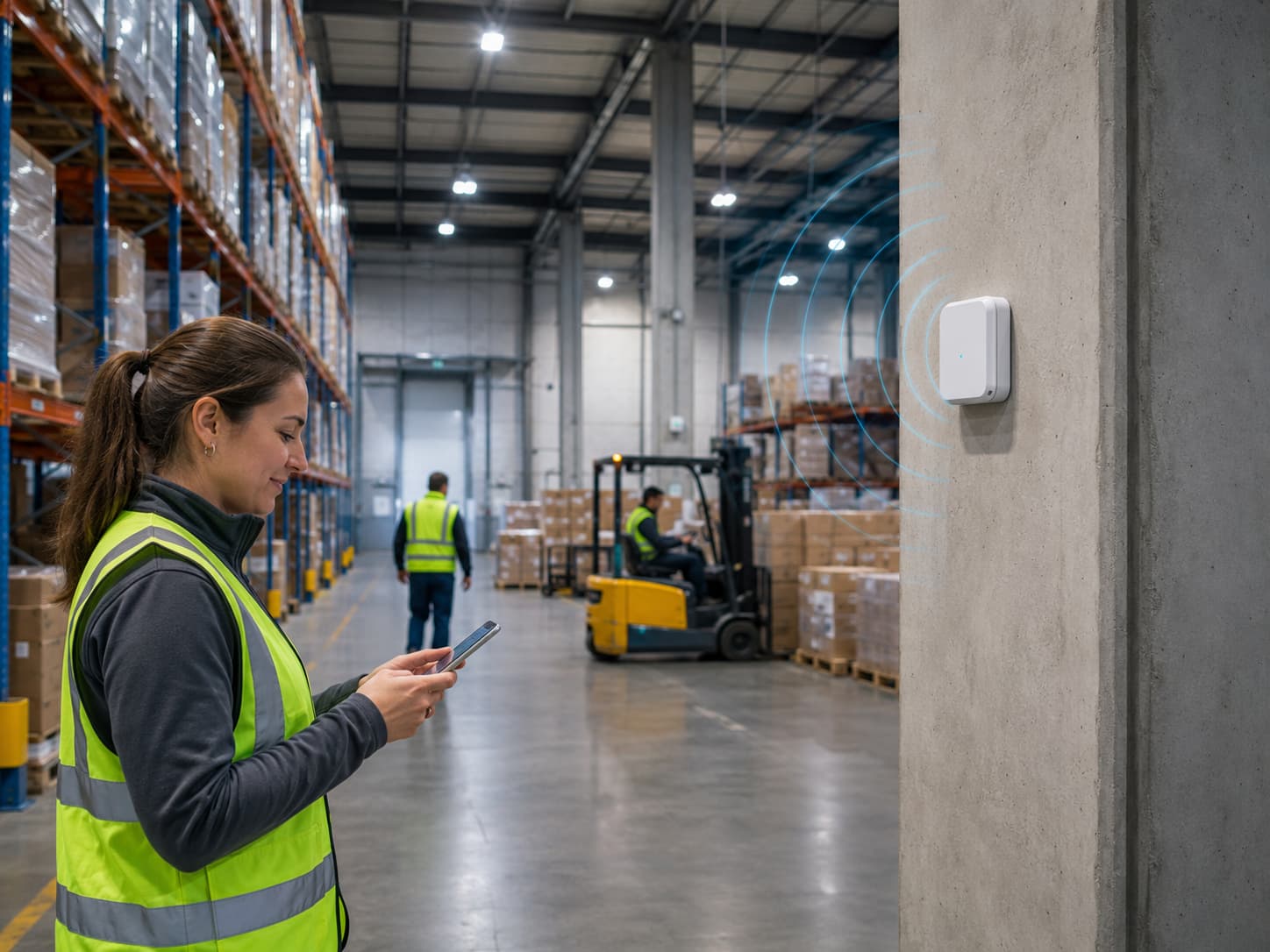
A femtocell attacks the problem from the opposite direction. Instead of trying to push a stronger signal from a distant tower through your walls, it places a tiny base station inside the building itself. The device is small, no larger than a home router, and low in power. It sits in your living room or office, and it creates its own little pocket of cellular coverage right where you need it. Because your phone is now only a few meters from a base station rather than kilometers from a tower, the connection becomes strong and stable, and the dead zones simply disappear.
What makes the trick work is the way the femtocell connects back to the operator. Rather than relying on a wireless link to the tower network, it uses your existing broadband internet connection, the same cable or fiber line that carries your home Wi-Fi. The femtocell takes your phone’s call or data session, routes it over that broadband link, and delivers it into the operator’s core network somewhere else entirely. From the network’s point of view, you are connected as normal. From your point of view, the weak outdoor signal has been quietly bypassed. This is why the technology is sometimes described as a bridge between fixed broadband and mobile telephony, combining the two into a single seamless experience.
The femtocell belongs to a broader family that engineers call small cells, of which it is the smallest and most domestic member. A residential unit typically supports somewhere between four and eight active phones at once, which is plenty for a household, while enterprise versions built for offices can handle roughly eight to sixteen simultaneous connections. The concept is not tied to any single generation of technology. It has been applied across older standards and carried forward into modern ones, which means the same basic idea keeps finding new life as networks evolve.
The benefits reach further than simply holding a call together. Because your phone no longer has to shout across a long distance to reach a far-off tower, it can transmit at much lower power. That reduced effort translates directly into longer battery life, a quiet advantage that users feel without ever knowing why. Voice quality improves as well, since a clean, close connection can carry richer audio. And the improvement is not only for the customer. For the operator, every phone served by a femtocell is a phone that is no longer drawing on the capacity of the crowded macrocell outside. The femtocell offloads that traffic, easing congestion on the main network and, in many cases, letting the operator improve indoor coverage without the enormous expense of building more towers.
That economic logic is a large part of why operators have embraced the approach. Erecting and maintaining macro base stations is costly and slow, tangled in permits, real estate, and infrastructure. Handing customers a small device they can plug in themselves shifts part of the coverage problem to the edge of the network, using resources, the broadband line and the electrical outlet, that the customer already pays for. It is a remarkably efficient division of labor, and it lets carriers fill in coverage gaps building by building rather than region by region.
The technology is not without its complications. Because a femtocell creates a genuine slice of licensed cellular network inside a private home, it has to be managed carefully so that it does not interfere with the surrounding macro network. Questions of which phones are allowed to connect, how calls hand over smoothly when a user walks out of the femtocell’s range and back onto the tower, and how the device is provisioned and secured all require thoughtful engineering. Early deployments had to work through exactly these issues, and the lessons learned shaped how small cells are managed today.
Seen in the wider picture, the femtocell represents a quiet but important shift in how networks are built. For decades the assumption was that coverage flowed outward from ever larger and more powerful towers. The femtocell inverts that assumption, bringing the network’s edge directly into the spaces where people live and work. As demand for reliable indoor connectivity keeps rising, driven by video, remote work, and an ever-growing number of connected devices, that inversion only becomes more valuable. The humble box on the shelf, easy to overlook, turns out to be one of the more elegant answers to a problem nearly everyone has felt but few could name.